
UBA leads three site tours for the CCA developers
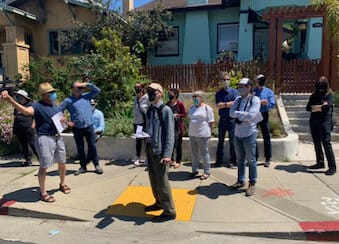
In 2021, UBA led three tours of the CCA site and neighborhood for the developers and their design, architecture, and landscape teams — making the case for human-scale design rooted in Rockridge's traditions.
In March 2021, developers Emerald Fund and Equity Community Builders (Emerald/ECB) gave a slide presentation to UBA showing their thinking so far on the CCA site. It appeared to us that the developers viewed the CCA site as an extension of the Broadway corridor, with its high-rises and cold, impersonal aesthetic — whereas we see it as the southern anchor to College Avenue, with its small businesses and green, walkable neighborhoods.
As we wrote in a follow-up letter: “Remember that the vast majority of space in Rockridge is residential, and that is where the Rockridge style can be found. It is not wildly eclectic at all… but consistently rooted in tradition. The details may vary — even the styles, from Craftsman to Mediterranean — but they show a respect for historic values: masses, colors, rhythms, materials, relation to the street, landscaping, trees.”
UBA then led three tours of the CCA site and neighborhood for key members of the development team:
- Tour 1 — Design Guidelines (May 2021): A tour for SiteLab, engaged by Emerald/ECB to develop Design Guidelines for the site. UBA also provided a comprehensive list of items of historical value we believe should be preserved.
- Tour 2 — Neighborhood Architecture (July 2021): A tour with the new project architect, Mithun. We discussed the challenge of creating human-scale buildings that are also tall and dense, and advocated for genuine recognition of the site’s history and for 20% affordable housing.
- Tour 3 — Landscaping (August 2021): A tour for CMG Landscape Architects. We emphasized the importance of trees, greenery, and open space in our park-starved area, and our alarm at the disappearing trees and shrubbery on the site.
Our purpose throughout was to show the prevailing, largely traditional architecture of the neighborhood as a model for design that respects the context of Rockridge — welcoming, human-scale, and open to the street.